

May 8, 2025
NCRI Reveals Secret Iranian Nuclear Weapons Facility under Petrochemical Cover
New Intelligence Uncovers Tehran’s Advanced Warhead Development with a potential for Hydrogen Bomb capability
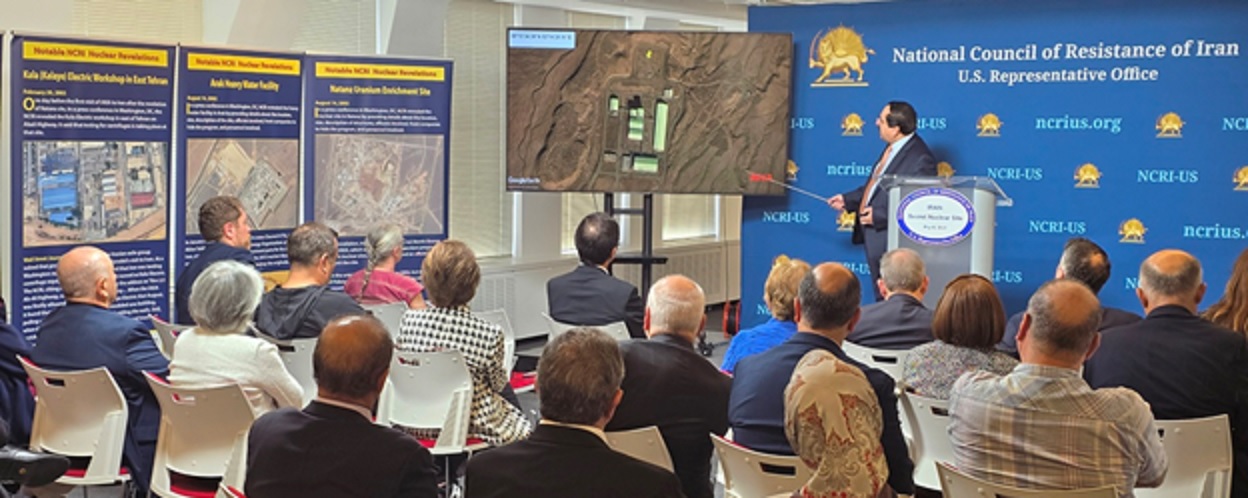
Washington, DC – May 8, 2025 – At a press conference, the U.S. Representative Office of the National Council of Resistance of Iran (NCRI-US) unveiled critical new intelligence about a clandestine nuclear weapons facility operated by the Iranian regime. The findings, presented by NCRI officials, expose Tehran’s continued pursuit of nuclear weapons capabilities under the guise of petrochemical activities.
Soona Samsami, U.S. Representative of the NCRI, revealed that the facility—known internally as the Rangin Kaman (Rainbow) Site—is located near Ivanaki (Eyvanekey), approximately 55 kilometers southeast of Tehran. Spanning over 2,500 acres, the site operates under the cover of Diba Energy Sina Company, a front posing as a chemical production entity.
“This is not a peaceful program. This is a weapons project designed to produce nuclear warheads that can be mounted on missiles with ranges exceeding 3,000 kilometers,” Samsami stated. “Iran’s nuclear infrastructure must be dismantled, enrichment must be halted, and the IAEA must verify the full closure of these sites. The regime’s nuclear ambitions are part of a survival strategy fueled by repression and deception.”
Since Masoud Pezeshkian took office as the regime’s president in 2024, Samsami noted, the regime has executed over 1,200 prisoners, including political detainees, highlighting an increasingly desperate regime facing mounting domestic dissent.
Alireza Jafarzadeh, Deputy Director of NCRI-US, detailed the findings based on intelligence provided by the MEK’s network inside Iran. The same network first exposed the Natanz and Arak nuclear sites in 2002. “This investigation began over a decade ago and includes names, organizations, structures, and on-site details. The site’s development began in 2009 under the supervision of the assassinated nuclear weapons chief Mohsen Fakhrizadeh and became operational in 2013.”
Jafarzadeh described how the Organization of Defensive Innovation and Research (SPND)—a body under the Ministry of Defense—has led the program. Key to the project is the extraction and use of tritium, enabling higher-yield nuclear weapons and the potential development of hydrogen bombs.
In September 2005, the Iranian Resistance revealed that the regime had illegally purchased tritium from South Korea. In 2008, the German government blocked the transfer of a shipment of tritium gas to Iran. Also, since 2013, the SPND organization has recruited and employed nuclear fusion and tritium specialists. To this end, some experts were transferred from the Nuclear Fusion Division of the Atomic Energy Organization of Iran to SPND, a process carried out with maximum secrecy.
To hide the military nature of the program, the regime established a network of front companies. The parent firm, Pishtazan-e Tose’e San’ati Aria Razi (PESTAR), oversees several subsidiaries, including Diba Energy Sina. The company’s board has included high-ranking IRGC and Ministry of Defense officials, including Brigadier General Naser Maleki, who was sanctioned under UN Security Council Resolution 1747 for involvement in nuclear and missile activities.
The Ivanaki site includes underground facilities, multiple factory-style hangars, and a heavily militarized perimeter. It is protected by a Ghadir long-range radar system and a nearby missile defense unit deployed by the IRGC Aerospace Force—clear indicators of the site’s strategic sensitivity.
“The regime told locals it was building a paint or petrochemical facility, but the fencing, cameras, and military roadblock reveal its true nature,” Jafarzadeh said. “This is part of a deliberate and sustained effort to continue Iran’s nuclear weapons program under deeper concealment.”
The NCRI called on the international community to invoke the UN snapback mechanism to reimpose all Security Council sanctions, halt all enrichment activity by the regime, shut down the entire nuclear program of Tehran, and have the IAEA monitor the dismantling of the nuclear program of Iran. It also called on the international community to recognize the right of the Iranian people to resist and replace the religious dictatorship ruling Iran and its IRGC protectors, with a democratic, secular, and non-nuclear republic.
Iran’s regime is not merely pursuing nuclear weapons as a deterrent—it views them as a guarantee for its survival. While spending over $2 trillion on its nuclear ambitions, the regime has left Iran’s energy and civilian sectors in decay.
As domestic unrest escalates and more than 1,200 executions under the regime’s President Pezeshkian reflect a deepening crisis of legitimacy, Tehran’s nuclear gamble poses a global threat. The world must act now—both to stop the Bomb, and to stand with the Iranian people fighting for a free Iran.
The comprehensive report with detailed findings, maps, and documentation shared at the press conference is available here.
