

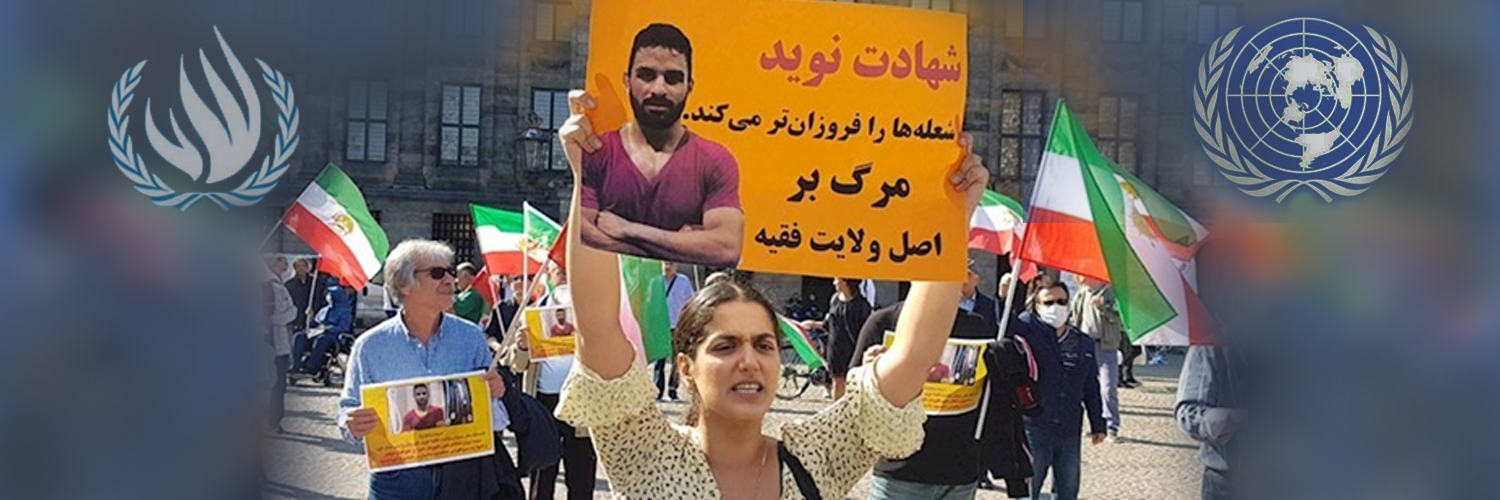
Execution of Iran athlete sends deeply disturbing message to protesters, say UN experts
GENEVA (14 September 2020) – UN human rights experts today strongly condemned the summary execution of champion wrestler Navid Afkari in Iran, raising alarm at the latest execution in a series of death penalty sentences handed down in the context of protests in 2018 and 2019.
“It is deeply disturbing that the authorities appear to have used the death penalty against an athlete as a warning to its population in a climate of increasing social unrest,” the experts said, while sending their condolences to Navid Afkari’s family.
“Such flagrant disregard for the right to life through summary executions is not only a matter of domestic concern. We call on the international community to react strongly to these actions by the Islamic Republic of Iran.
“The execution of Afkari, the second execution in connection to protests in the last two months, together with the alarming frequency of death penalty sentences handed to protesters raises concerns about the authorities’ future response to protests and to any expression of opposition or dissenting opinion.”
Navid Afkari participated in the protests in Shiraz in 2018. He was arrested on 17 September 2018, accused of killing a security guard. He was subsequently found guilty and sentenced to death under qisas (retribution in kind) by a Criminal Court in Fars Province. In a separate trial, Branch 1 of the Revolutionary Court in Shiraz convicted Afkari for moharebeh (taking up arms to take lives or property and to create fear in the public) and sentenced him to death a second time. On 25 April 2020, the Supreme Court upheld the conviction for murder and the accompanying death sentence under qisas while the death sentence for moharebeh ordered by the Revolutionary Court was still under appeal.
“If Afkari was guilty of murder, why was the trial conducted behind closed doors and through the use of forced confessions extracted under torture? The execution of Navid Afkari was summary and arbitrary, imposed following a process that did not meet even the most basic substantive or procedural fair trial standards, behind a smokescreen of a murder charge,” the experts said.
Navid Afkari complained to the judiciary, claiming officials had severely beaten him on his arms, legs, abdomen and back with sticks and batons, that they covered his head with a plastic bag and suffocated him to the brink of death and poured alcohol into his nose.
“We are appalled at these serious allegations of torture which have not been investigated, the broadcasting of his forced confession by state television, and the use of closed and secret trials,” the experts said, stressing the “the inherently cruel, inhuman and degrading nature of the death penalty”.
Under Iranian law, death sentences for qisas allow the family of the convicted person to seek pardon from the family of the murder victim. The family of Afkari had just arrived at the airport in Shiraz for the purpose of meeting with the family of the murder victim, when they were informed that the execution had been implemented on 12 September. Individuals are also entitled to a last family visit prior to execution, a right they were denied. Navid Afkari was buried secretly at night, and the family was only subsequently allowed to see his face.
“The course of events in Navid Afkari’s case raise serious doubts about the veracity of the basis for the murder charge against him. The hastened secret execution, forced confession under torture as the sole evidence, closed trial and the lack of respect for the domestic requirements for reconciliation and the denial of a last family visit suggest that there was an attempt by the authorities to expedite his execution,” the experts said.
The UN experts urged the Government of the Islamic Republic of Iran to respect its obligations under international law and immediately halt all executions of protesters sentenced to death.
“We recall once again that, if the death penalty is to be used in countries that have not yet abolished it, international law requires that it only be imposed after proceedings that meet the highest level of respect of fair trial and due process standards. The ‘most serious crimes’ provision further requires that it is imposed only for the offence of intentional killing,” the experts noted, highlighting that the persistent execution of individuals for exercising their rights to freedom of expression, association and peaceful assembly contravenes universally accepted human rights principles and norms.
https://www.ohchr.org/EN/NewsEvents/Pages/DisplayNews.aspx?NewsID=26231&LangID=E
